
The Rega Planar 6 RS Edition Review
The Rega Planar 6 RS Edition Review £2000
Most special editions are cosmetic. A different colour, a commemorative plaque, perhaps a bundled accessory — something to justify a higher price without changing what the product actually does. The Rega Planar 6 RS Edition is not that kind of product. It takes the Planar 6 platform and fits it with the tonearm and cartridge from the Planar 8 — components that in standard configuration cost considerably more. That is not a styling exercise. That is a fundamental change to what the turntable can retrieve from a record.
The Planar 6 RS Edition is priced at £2,000. Understanding what that figure represents requires understanding what the RS Edition actually is — and why the component upgrades it carries are not incremental but transformative.
The Planar 6 Platform
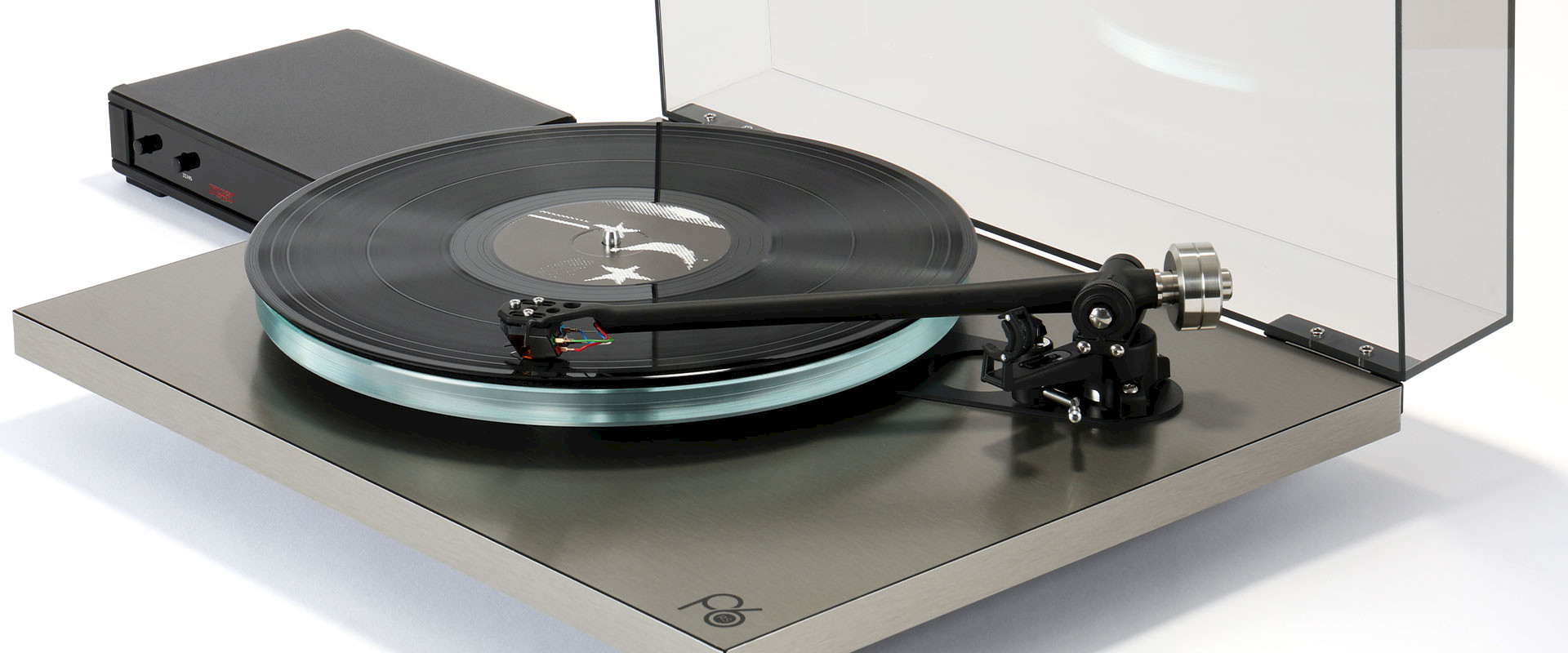
The Planar 6 platform is where Rega’s engineering philosophy begins to operate without compromise. The plinth is built from Tancast 8 — a closed-cell polyurethane foam developed for aerospace applications, skinned on both faces with HPL (high-pressure laminate). The result is a plinth that is dramatically lighter than wood or MDF while being significantly stiffer. That combination is precisely what Rega has been pursuing since Roy Gandy challenged the industry’s love of mass in the early 1970s.
The conventional logic for heavy plinths runs like this: mass absorbs vibration. Gandy’s counter-argument was that mass stores energy and releases it again as distortion — the very problem it is supposed to solve. A rigid, lightweight structure does not store energy in the first place. It transmits vibration rapidly away from the bearing and stylus rather than holding it in the signal path. Tancast 8 takes this principle further than any material Rega had previously used.
The platter is dual-layer float glass — 16mm of inert, precisely flat material that provides a stable rotating platform for the record. Float glass is dimensionally consistent in a way that materials like acrylic or felt-covered platters simply are not, and its mass provides the rotational inertia needed to keep speed consistent through the stylus-groove interaction.
Both the standard Planar 6 and the RS Edition include the Neo PSU as standard. The Neo is an external precision-regulated power supply that connects to the turntable via Mini DIN. Its function is to deliver precisely controlled power to the 24V synchronous motor, eliminating the mains frequency variations that cause speed instability in turntables without regulated supplies. Speed consistency is not an abstract specification — it directly affects pitch stability and timing, which are the qualities that determine whether music sounds natural and properly rhythmic or subtly uncertain. The Neo is not an optional upgrade here; it is the foundation on which the RS Edition’s higher-specification components are asked to perform.
The standard Rega Planar 6 (from £1,280) gives you this platform with the RB330 tonearm and no cartridge at the base price. That is already a serious turntable. What the RS Edition does is reveal how much further the platform can go when its less-capable components are replaced.
The RB880 Tonearm
The RB880 is the tonearm fitted to the Planar 8 — Rega’s product one step below their flagship Naia. In standard Planar 6 configuration, the arm fitted is the RB330. Both are good arms. The gap between them is not small.
The defining characteristic of the RB880 is its bearing assembly. Rega specifies zero-tolerance bearing adjustment to less than one-thousandth of a millimetre. That figure matters because bearing play — any looseness in the bearing housing — allows the arm to move in directions other than the intended tracking plane. Even tiny amounts of play create friction variations that prevent the stylus from tracking the groove with full fidelity. They also introduce a mechanical noise floor that masks fine detail in the groove.
When bearing precision is this high, the cartridge can respond to the full resolution of what the groove contains rather than a filtered version of it. In practice, this manifests as improved instrument placement in the stereo image — the RB880 positions voices and instruments with a specificity that the RB330 cannot fully match. In complex passages, where multiple instruments are playing simultaneously, the RB880 maintains composure and separation where lesser arms begin to compress the presentation. Individual instruments remain distinct; the decay of notes in reverberant spaces can be followed individually rather than blurring into an undifferentiated wash.
The RB880 is also built with improved internal wiring compared to the RB330 — lower-capacitance silver-plated copper that maintains the signal integrity between the cartridge and the phono stage. The cumulative effect of tighter bearings, better wiring, and more refined construction is an arm that simply gets out of the way of the cartridge’s job. That is exactly what a tonearm is supposed to do.
The Nd9 Cartridge
The Nd9 is Rega’s reference moving magnet cartridge. It is not simply a step up from the Nd5 fitted to the Planar 3 RS Edition — it is a different order of engineering. The cantilever is boron, rather than the aluminium used in most MM cartridges. Boron is significantly stiffer and lighter than aluminium, which means the stylus tip responds to transients — the sharp leading edges of notes, the attack of percussion, the initial consonants of a voice — with greater speed and accuracy. Aluminium cantilevers flex slightly under the forces involved in groove tracking; boron resists that flexing.
The generator — the coil-and-magnet assembly that converts stylus movement into electrical signal — is wound by hand using 38-micron wire. That is exceptionally fine: thinner wire means fewer turns needed to achieve the required output, which reduces inductance. Lower inductance improves high-frequency extension and phase accuracy, and reduces the interaction between the cartridge and the input capacitance of the phono stage. The hand-winding process also achieves tighter channel-to-channel consistency than automated winding can deliver, which translates directly into better stereo image stability — the phantom centre image in a recording stays fixed and convincing rather than wandering slightly with programme material.
The Nd9’s resolution is genuinely challenging for the lower end of the moving coil range. That is significant because moving coil cartridges — with their lower-mass generators and more sophisticated construction — have traditionally held a clear advantage in detail retrieval over moving magnets at equivalent price levels. The Nd9 narrows that gap substantially, recovering low-level information from the groove — the texture of a bowed string, the room ambience behind a vocal, the fine harmonic structure of a piano note — with a delicacy that most MM cartridges at this price cannot match.
The combination of the RB880 and Nd9 is not an accidental pairing. The arm is precise enough to let the cartridge fully demonstrate what it can do, and the cartridge is resolving enough to make the arm’s precision audible. Fitting the Nd9 to a lesser tonearm would waste much of its capability. Fitting a lesser cartridge to the RB880 would do the same in reverse. Rega has chosen these two components because they are matched in capability — a coherent upgrade rather than two independent improvements.
Where It Sits in the Range
Understanding the RS Edition’s value requires seeing where it falls in the broader Rega range.
Below it sits the Rega Planar 3 RS Edition (£1,099) — an excellent turntable on a different platform, with an RB330 tonearm and the Nd5 cartridge. The Planar 3 RS Edition is a compelling complete package, but it operates within the limits of the Planar 3 platform. The Tancast 8 plinth in the Planar 6 is a different class of engineering, and the Nd9 is a cartridge of appreciably higher resolution than the Nd5. These are not equivalent products at different price points — they are different tiers of what vinyl playback can do.
Above the RS Edition sits the Rega Naia (£10,500) — Rega’s current flagship, with an RB Titanium tonearm, graphene-reinforced carbon fibre plinth construction, and a cartridge at the apex of what Rega makes. The Naia is a reference product at a reference price. The Planar 6 RS Edition is not the Naia.
What the Planar 6 RS Edition (£2,000) represents is a gap that does not normally exist in a manufacturer’s range: Planar 8 tonearm and reference MM cartridge on the Planar 6 platform, at £2,000. The standard Planar 8 costs £2,398 and comes with the RB880 but without the Nd9. The RS Edition is not simply a cheaper route to similar performance — it is a specific, considered combination built to a particular price point and assembled by hand as a special run. Once current stock is gone, it will not be straightforwardly replaceable.
System Matching and Phono Stages
The Nd9 is a moving magnet cartridge, which means it is compatible with any MM phono input — built into an amplifier or as a standalone phono stage. No phono stage is included with the Planar 6 RS Edition. At this level of turntable, phono stage quality matters significantly. The Nd9 will show you the difference between a competent entry-level phono stage and a better one in a way that less resolving cartridges will not.
The Rega Fono MM MK5 (£230) is Rega’s current entry phono stage and a solid performer for its price. It will get the RS Edition working well. If budget allows for nothing more, it is a sensible and coherent choice. But we would be honest with you: at £2,000 for the turntable, the Fono MM MK5 is a modest stage for what the Nd9 can resolve. It works, and the combination will still outperform most vinyl setups at the price. It is simply not the ceiling.
The Rega AOS MC Phono Stage (£1,500) is a significant step forward. Though it supports MC input as well as MM, it also handles MM at a level of quality that better matches the Nd9’s capability. It also future-proofs the system: if you later choose to move to a moving coil cartridge, the AOS is already there. At £1,500 it represents a substantial additional investment, and we would not suggest it without knowing your amplification, budget, and plans. But if you are building a serious vinyl system rather than simply buying a turntable, it is worth understanding what it does.
We are happy to advise. The right phono stage depends on your existing equipment, your room, your amplifier’s own phono input quality if it has one, and whether you intend to stay with MM or move to MC in the future. There is no single correct answer, and we would rather give you the right advice for your specific situation than a simple recommendation by default.
Hear It in Norwich
The Planar 6 RS Edition is on demonstration at Martins Hi-Fi. If you want to hear what the RB880 and Nd9 actually do to a familiar record, come and listen. Ask for Dave or Chris when you call ahead — either can walk you through the system and set up a proper demonstration with material you know.
We have been trading since 1968 and are an authorised Rega dealer. Analogue is a significant part of what we do. If you have questions about matching the RS Edition to your existing system, or about phono stages, or about where it sits relative to other options we carry, we are happy to talk through all of it before you make any decision.
Call us on 01603 627010, email info@martinshifi.co.uk, or reach us on WhatsApp at 07554 687137. We are at 85–91 Ber Street, Norwich, NR1 3EY, open six days a week.
Shop the Rega Planar 6 RS Edition — or explore the full Rega range at Martins Hi-Fi. Find out more about why to buy from Martins.