
Lowering the Noise Floor: An Afternoon of Demonstration at Martins Hi-Fi 15th May
Lowering the Noise Floor: An Afternoon of Demonstration at Martins Hi-Fi
We are hosting a special event at our Norwich showroom dedicated to one of the most rewarding — and most overlooked — aspects of hi-fi: lowering the noise floor. Join us for an afternoon of live demonstrations, honest conversation, and serious music, as we show what a well-tuned system is truly capable of.
Most hi-fi systems are held back not by their components, but by interference they were never designed to handle. RFI from domestic wiring and devices, mains-borne noise from the grid, network interference, and even mobile phones in the listening room all raise the noise floor of a system — masking fine detail, softening transients, and blurring the low-level information that makes recordings come alive. The goal of Lowering the Noise Floor (LTNF) is simple: preserve as much of the original audio signal as possible, so you hear more of what the recording actually contains.
The results, when demonstrated properly, are not subtle. Our event will show this practically: a high-quality reference system, then LTNF products applied systematically so you can hear exactly what each one contributes. Come once and you will understand why serious listeners treat this as seriously as they treat component selection.
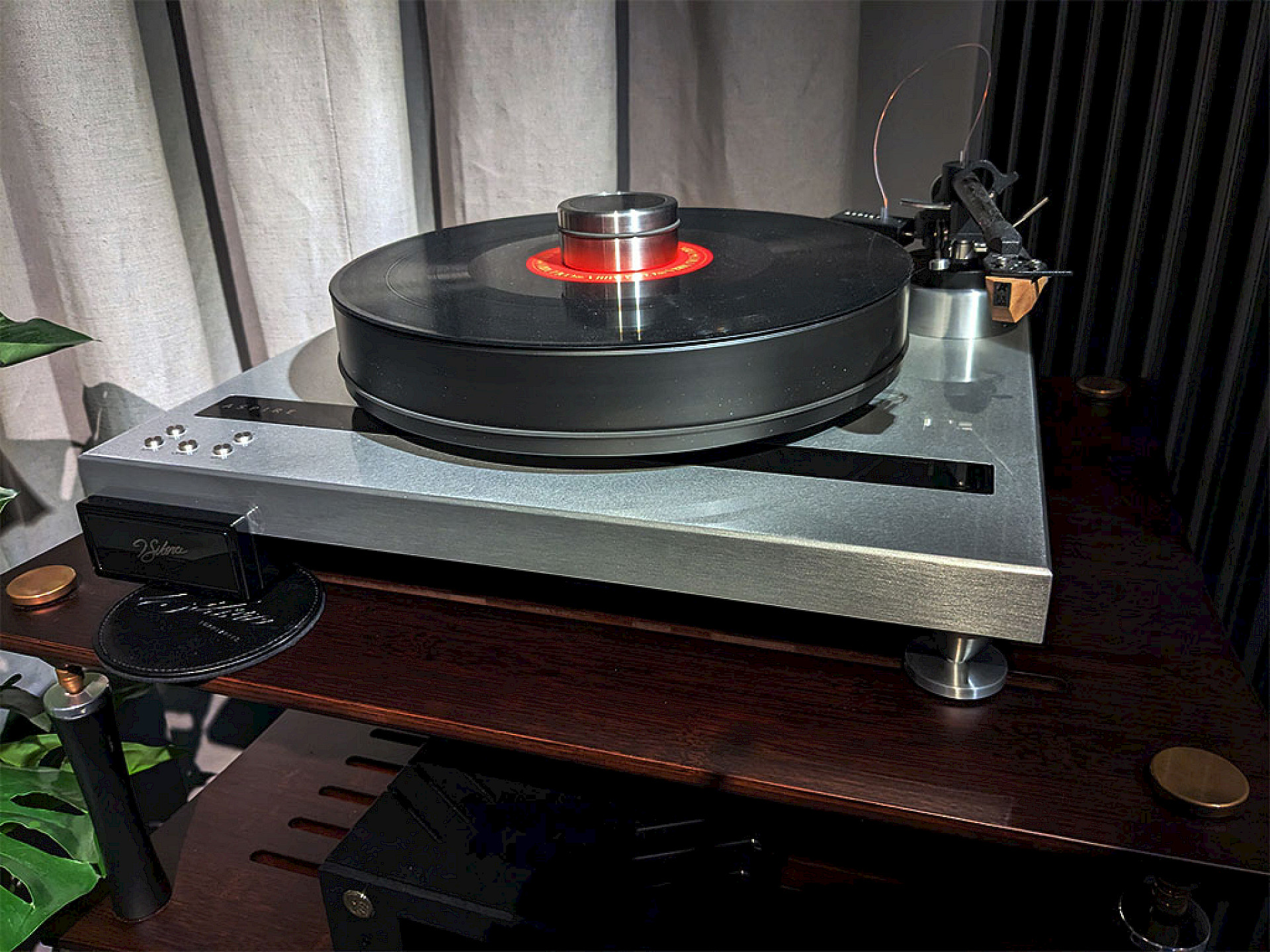
The Reference System
The foundation of the demonstration is the J Sikora Aspire turntable with an Analogue Relax moving coil cartridge — an analogue front end chosen specifically for its resolution and its ability to reveal exactly what is happening elsewhere in the chain. A system that glosses over problems would be useless for a demonstration like this. The J Sikora Aspire is built with the precision engineering that Polish turntable manufacturing has become known for, and it provides the stable, low-noise mechanical platform that the demonstration requires.
The Analogue Relax cartridge continues Japan’s long tradition of obsessive moving coil craft. These are small-batch, hand-assembled cartridges built around premium cantilever materials — boron and ruby are used across the range for their exceptional stiffness-to-weight ratios — and advanced stylus profiles including line-contact and micro-ridge geometries that trace the groove wall with an accuracy that elliptical designs simply cannot match. The Analogue Relax cartridge on this system is there because it is resolving enough to make the improvements from LTNF treatment clearly audible. It will not flatter or conceal.
The electronics are a full Gold Note stack, assembled from the Florentine manufacturer's reference range: the PH-10 or PH-1000 phono stage, DS-1000 line stage, PA-1175 MK2 power amplifier, Tube-1006 valve stage, and PSU-1000 dedicated power supply. Gold Note build their components with the same philosophy throughout: technically accomplished, musically intelligent, and designed with the understanding that measured performance and listening satisfaction are not always the same thing. This is a balanced, revealing stack — coherent across the signal path and sensitive enough to expose the improvements that LTNF treatment delivers.
Loudspeakers for the day are the OePhi Transcendence 2.5, with cabling throughout from OePhi and Entreq. The system is well-resolved at every stage. This matters: LTNF treatment has the most audible impact in systems with the resolution to reveal a lower noise floor. You will hear what this system sounds like before treatment is applied, and what it sounds like after. The difference is the point of the afternoon.
What Is Being Demonstrated
AIRT AUDIO will host the demonstration sessions, covering four distinct areas of noise floor management. Each targets a different mechanism by which interference degrades audio performance.
Stillpoints — Mechanical Isolation
Every component in your system is vulnerable to vibration. Transformers, capacitors, and resistors are microphonic to varying degrees — they generate noise when mechanically agitated, and that noise contaminates the signal they are handling. The source of vibration is not just the loudspeakers: floor-borne energy from the building, acoustic energy in the room itself, and the mechanical activity within components all play a role.
Stillpoints address this with a patented internal mechanism — a precision ball-bearing rolling in a cupped surface with a specific geometry — that diverts mechanical energy into heat through internal friction rather than passing it to the component above. The mechanism works across a broad frequency range, including the difficult low-frequency vibrations that rubber feet and spring isolators fail to address. The Ultra series ranges from the Ultra Mini through to the Ultra 5 and Ultra 6, with progressively more complex nested cup mechanisms for higher levels of isolation. The improvement is cumulative: the more sensitive the component, the more dramatic the result. Turntables benefit enormously. So do digital sources, DACs, and phono stages.
Entreq — System Grounding
The second demonstration area addresses the electrical environment rather than the mechanical one. Mains-borne noise and RF contamination are present in every domestic electrical system, and they enter audio components through the power supply and through the ground connection. Conventional mains earth is designed for safety, not audio performance — it is a shared reference that carries contamination from every device on the same ring.
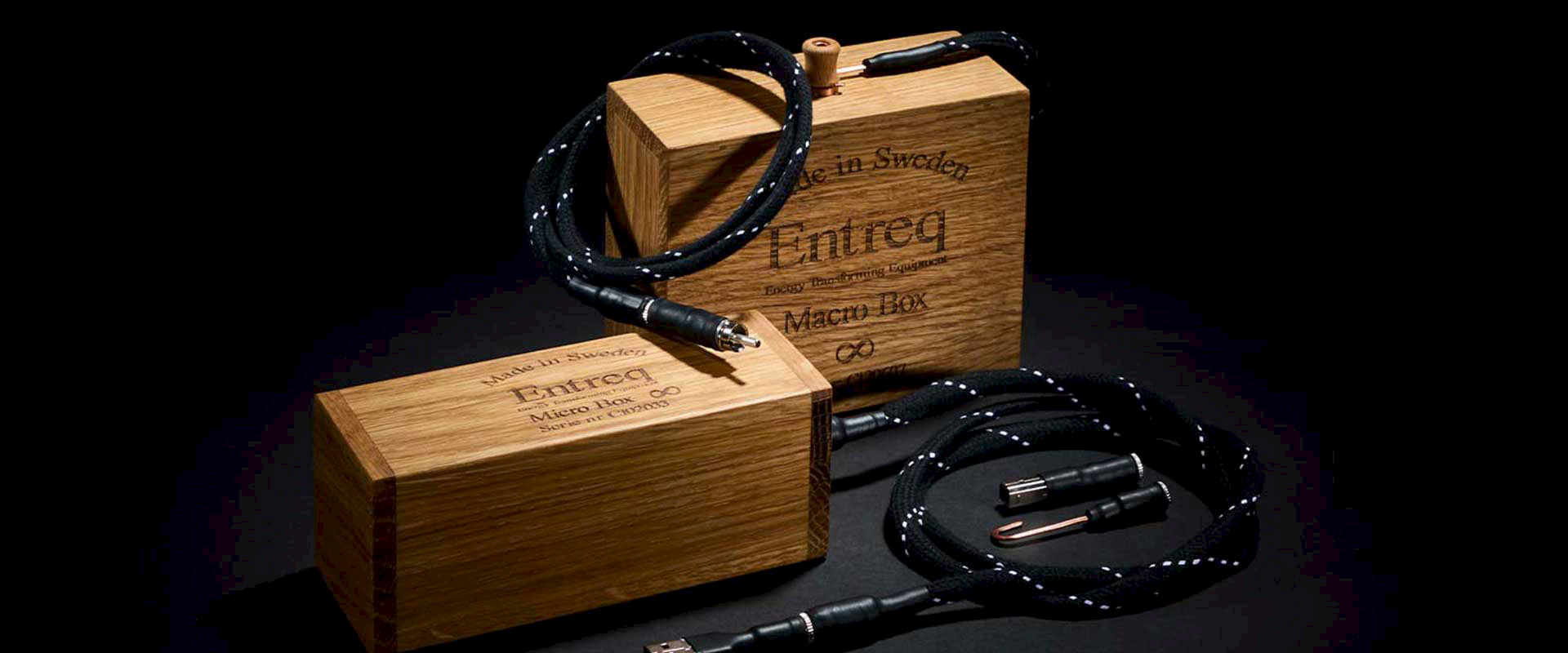
Entreq's solution is the ground box: a passive device filled with a proprietary mixture of minerals and metals that provides a highly effective, low-impedance sink for electrical noise and RF contamination. Ground boxes are connected to the chassis earth of audio components via Entreq's silver cables, drawing noise away from the component into the mineral matrix where it is dissipated without being returned to the circuit. This is not filtering or active noise cancellation — it is a passive grounding system based on principles long established in professional recording and broadcast environments. The improvement is typically described as an unveiling: greater bass definition, cleaner extended treble, more low-level detail, and a more natural presentation that makes listening easier and more engaging.
Entreq — Magnetic Field Management
The third area covers electromagnetic interference — the effect of magnetic fields on sensitive components, particularly those handling low-level signals. Phono stages, which amplify signals in the millivolt range, are especially susceptible. Entreq's approach here involves specific products designed to manage the local magnetic environment around sensitive components, reducing the contamination that reaches the signal path before it can be amplified.
Acustica Applicata — Room Acoustics
The fourth and final area may be the most important of all, and the most consistently neglected. Your room is as much a part of your system as any component in it. Excessive bass energy building up in corners and along walls muddies the low end and masks low-level detail. First reflections from side walls and the ceiling smear imaging and compress the soundstage. Flutter echo between parallel surfaces obscures fine musical detail.
Acustica Applicata, the Italian acoustic treatment manufacturer, addresses all three problems with targeted, beautifully finished panels designed for domestic environments. The AGEA absorber panels tackle mid and high-frequency reflections. The DADO diffusers manage the rear wall without deadening the space — scattering reflected energy to preserve a sense of room life while eliminating the smear of flat-surface reflections. The SITIA bass traps, designed for corner placement, address the low-frequency standing waves that dominate most domestic listening rooms. The improvement from properly implemented room treatment is frequently more dramatic than swapping components — and Acustica Applicata's design-conscious approach makes it viable in rooms where industrial-looking treatment would be unacceptable.
The Sessions
AIRT AUDIO will run three informal sessions throughout the afternoon:
12:00
14:00
16:00
Each session covers how, why, and the practical importance of LTNF treatment across all aspects of hi-fi — from analogue to digital, in systems both modest and ambitious. The demonstrations are practical and comparative: you will hear before and after, with each layer of treatment added and explained.
There is no obligation and no sales pressure. Come to one session or stay for all three. If you have questions about your own system — whether a specific piece of treatment would be appropriate, what to prioritise, how to approach a difficult room — the AIRT AUDIO team will be on hand to discuss your specific situation.
About Martins Hi-Fi
Martins Hi-Fi has been in Norwich since 1968. Elizabeth Gould runs the business today, and we stock only brands we have heard properly and stand behind. The products featured in this event — Stillpoints, Entreq, and Acustica Applicata — are in our range because we have listened to what they do and we are confident in the results. If you have ever suspected your system has more to give, this is the afternoon to find out.
Practical Details
The event takes place at Martins Hi-Fi, 85–91 Ber Street, Norwich, NR1 3EY. Sessions run at 12:00, 14:00, and 16:00 — no booking is required, though registering your interest helps us plan the day.
Contact us at info@martinshifi.co.uk, call 01603 627010, or WhatsApp on 07554 687137 to register your interest or ask any questions in advance. We look forward to seeing you.
—
Martins Hi-Fi
85-91 Ber Street, Norwich NR1 3EY
01603 627010
info@martinshifi.co.uk